
…In each case, we pondered what the business was likely to do, not what the Dow, the Fed, or the economy might do. If we see this approach as making sense in the purchase of businesses in their entirety, why should we change tack when we are purchasing small pieces of wonderful businesses in the stock market?
———Warren Buffett’s Letters to Berkshire Shareholders, 1994.
Category: 股票
-
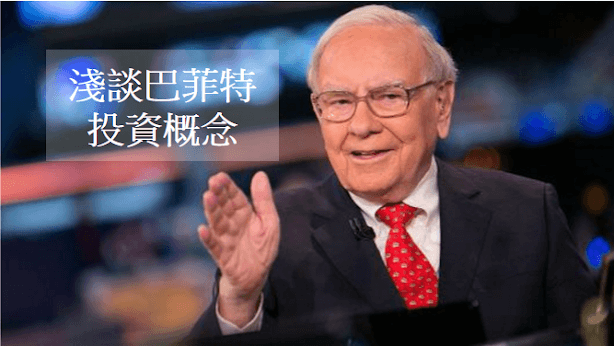
淺談巴菲特投資概念●5.巴菲特的投資方法
-
淺談巴菲特投資概念●4.投資人與選股
Intelligent investing is not complex, though that is far from saying that it is easy. What an investor needs is the ability to correctly evaluate selected businesses. Note that word “selected”:You don’t have to be an expert on every company, or even many. You only have to be able to evaluate companies within your circle of competence. The size of that circle is not very important; knowing its boundaries, however, is vital.
———Warren Buffett’s Letters to Berkshire Shareholders, 1996. -
淺談巴菲特投資概念●3.投資人與市場先生
In my opinion, investment success will not be produced by arcane formulae, computer programs or signals flashed by the price behavior of stocks and markets. Rather an investor will succeed by coupling good business judgment with an ability to insulate his thoughts and behavior from the super-contagious emotions that swirl about the marketplace. In my own efforts to stay insulated, I have found it highly useful to keep Ben’s Mr. Market concept firmly in mind.
———Warren Buffett’s Letters to Berkshire Shareholders, 1987. -
淺談巴菲特投資概念●2.總體經濟與市場預測
We make no attempt to predict how security markets will behave; successfully forecasting short term stock price movements is something we think neither we nor anyone else can do. In the longer run, however, we feel that many of our major equity holdings are going to be worth considerably more money than we paid…
———Warren Buffett’s Letters to Berkshire Shareholders, 1978. -
淺談巴菲特投資概念●1.投資與投機
We think the very term “value investing” is redundant. What is “investing” if it is not the act of seeking value at least sufficient to justify the amount paid? Consciously paying more for a stock than its calculated value – in the hope that it can soon be sold for a still-higher price – should be labeled speculation (which is neither illegal, immoral nor – in our view – financially fattening).
———Warren Buffett’s Letters to Berkshire Shareholders, 1992. (more…)